INSIDE 1:1 MENTORING
What Seven First-Year Sales Tell You
You sold seven in your first year and you are reading it as proof the brand failed. Ivanka Menken uses the First-Year Signal inside 1:1 Mentoring, a 6-month programme at AUD $1,500 per month ex GST, to separate the sales number from the evidence inside it: what each buyer asked before they bought, and what the page never answered. You leave with a written read of what year one proved, and one small next test.
The First-Year Signal is a tool inside the programme, not a separate product.
YEAR ONE, READ AGAIN
Seven sales. One question.
- SALES IN YEAR ONEt-shirts, sold online7
- BUYERS WHO ASKED FIRSTthe same question, by private message7 of 7
- ANSWERED ON THE PAGEthe gap to close first0
THE READ
“A small number is a data point. Read what is inside it before you decide what it means.”
Your sales and questions will be your own.
SOUND FAMILIAR?
A small number that feels like a verdict
- 01You treat the first-year sales number as the final score.
- 02You keep changing the product and posting more.
- 03Buyers ask you things in private that the page never says.
YEAR ONE, AS IT STANDS
- Sales: seven t-shirts
- Verdict so far: the brand has failed
- Fix tried: new designs, more posts
- What buyers asked first: not written down
- The next test: none set
A number with nothing read out of it yet.
THE EXAMPLE CASE
One first-year number, read properly
01
THE MOMENT
Seven sales and a decision to quit
It is the end of the first year. You count the orders and get seven. You have redrawn the designs twice and posted more than ever, and you are close to calling it. Nobody has gone back through the seven sales to ask what they had in common, or what the buyers wanted to know before they paid.
02
WHAT THEY HAD TRIED
New designs and more posts
The obvious fix was effort. The founder changed the designs, posted more often and waited for the number to move. It did not. Each round cost money and weekends, and the offer was still unclear, so every new design arrived on a page that left the same question open. More effort on an unclear offer made the founder more tired, not more certain.
03
WHAT IVANKA NOTICED
Every buyer asked the same question
Ivanka asked to see the messages behind the seven sales. Every buyer had asked the same question before purchasing, and the founder had answered it each time in private. The answer was nowhere on the page. The seven sales were the people patient enough to ask. The rest of the visitors had the same question and left.
THE DIAGNOSIS
The offer was working in private, not on the page
The diagnosis was not a demand problem or an effort problem. The offer was doing too much of its work in private messages and too little on the page. Year one had produced a clear signal, and nobody had read it.
The reframe: seven first-year sales is a data point, not a final score. The useful question is not whether seven is enough. It is what the seven had in common, and what the next small test should check. That turns a verdict into a decision you can make this month.
Seven sales is a data point, not a final score.
THE COST OF STAYING STUCK
Calling a small number a verdict can close a brand that was one clear answer away from its next buyers. Calling it a success can waste another year on the same page.
THE TOOL
The First-Year Signal, for one year of sales
The First-Year Signal reads a small launch number as evidence. It starts with the sales, then looks inside them: who bought, what they asked before buying, and what the page answered. The gap between what buyers asked and what the page said becomes the next change, and one small test checks it.
Tap a part. Your sales and questions are yours.
First-Year Signal · a framework by Ivanka Menken
What it is
It is one page. The first-year sales number, the questions buyers asked first, what the page answered, the signal in the gap, and one next test with a date and a count that decides what happens after it.
What it replaces
It replaces the verdict on a single number, the redesign that skips the evidence, and the hope that posting more will make an unclear offer clear.
It sits inside 1:1 Mentoring, next to the Fortnight Loop and the monthly Money-and-Clarity Scorecard. The read is written in a session and the test is reviewed in the next one. It is coaching, not a done-for-you marketing fix, and there is no separate checkout.
THE PAGE, FOR ONE YEAR
- 01The number: seven sales in the first year
- 02The buyers: who they were and how they found the page
- 03The question: what every buyer asked before paying
- 04The page: whether it answered that question
- 05The signal: the answer moved onto the page
- 06The test: one small next test, a date and a count
HOW IVANKA WORKED WITH THEM
Seven sales on one page
In the first session, Ivanka put the seven sales on one page and asked for the messages behind them. Together they wrote down the question every buyer had asked, and the answer the founder kept giving in private. Then she asked: what would change if that answer sat on the page? The founder rewrote the offer around it and chose one small test with a review date. Before the next session, the new page went live and the founder counted the replies.
THE FIRST-YEAR READ, AS WRITTEN
- What year one proved
- Seven people bought once their question was answered.
- What it did not prove
- That the brand has no market.
- The change
- The answer to the shared question, moved onto the page.
- The next test
- One small test of the rewritten offer, counted.
- Review
- At the next session
Your read will start from your own sales.
THE FOUR-STEP LOOP
- 1The one thingWhether to keep the brand after a seven-sale year.
- 2The numbersSeven sales, seven buyers, one shared question.
- 3The storyWhy seven felt like a verdict, not a signal.
- 4The commitmentOne rewritten offer and one small test, with a date.
THE QUESTIONS
- What did every buyer ask before paying?
- Where did you answer it?
- What does the page say instead?
- What is the smallest test of the new offer?
- Which count will decide the next step?
Before the next session, the founder put the answer on the page, ran the small test and brought back one count: how many visitors bought without needing to ask.
WHAT CHANGED
A signal read and a next test set
By month 6, the founder has a written read of year one, an offer that answers the buyers’ question on the page, and a next test decided by a count rather than a mood.
BEFORE
- Seven sales read as failure.
- The answer lived in private messages.
- Effort went into redesigns.
- No test, no review date.
BY MONTH 6
- A written read of what year one proved.
- The buyers’ question answered on the page.
- One small test run and counted.
- The next decision made from the count.
THE 12 FORTNIGHTS
- 1Call
- 2Call
- 3Call
- 4Call
- 5Call
- 6Month 3
- 7Call
- 8Call
- 9Call
- 10Call
- 11Call
- 12Month 6
The programme is the container: 12 fortnightly 60-minute sessions, a monthly scorecard, and reviews at month 3 and month 6.
ILLUSTRATIVE RESULT
In this case, the founder rewrote the offer around the question buyers kept asking and set a small next test instead of abandoning the brand. The change was in how the first-year number was read and what was tested next.
WHAT THIS MEANS FOR YOU
Read the number before you decide what it means
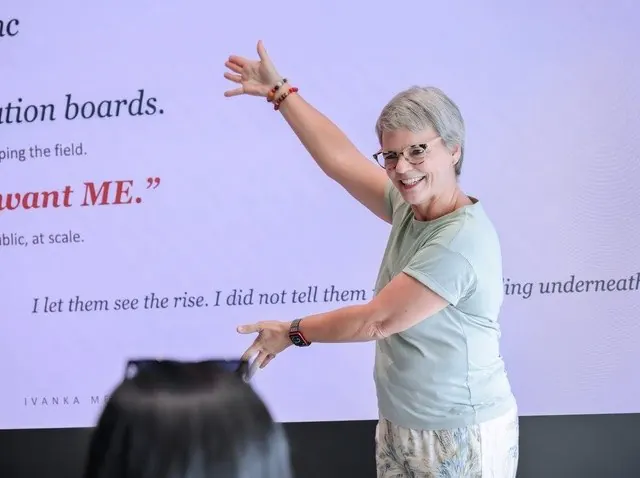
Ivanka Menken built 1:1 Mentoring for founders who want a clear head on the decisions that matter. She reads the evidence with you, asks the question you have been avoiding, and keeps you to the test you write down.
This fits if your first year was small and you are close to a big call: quit, pivot or push harder. It does not fit if you want someone to run your marketing. The decision in front of you is one read and one test. Go back through your sales and write down what every buyer asked.
“During our sessions Ivanka isn’t just talking theory. She is sharing her own lived experiences.”
Business owner
WHO IT IS FOR
It fits
- You sold a small number in your first year.
- You are close to quitting, pivoting or pushing harder.
- Your buyers asked you things before they paid.
- You will write the read down and run one test.
It does not fit
- You want a done-for-you marketing fix.
- You want open-ended coaching with no written commitments.
- You want someone to tell you the brand will work.
- You have not sold anything yet.
THE INVESTMENT
AUD $1,500
per month ex GST
6 months · 12 fortnightly sessions
The First-Year Signal is part of 1:1 Mentoring, a 6-month programme at AUD $1,500 per month ex GST. It is not sold separately.
- 12 fortnightly 60-minute sessions
- The monthly Money-and-Clarity Scorecard
- Reviews at month 3 and month 6
- The First-Year Signal for each launch decision
Three founding places in total, shared across 1:1 Mentoring and its three focus programmes, are available at A$1,000 a month, in return for honest monthly feedback and a testimonial, which can be anonymous. Claim a founding place.
The First-Year Signal is part of the programme. It is not sold separately.
FREQUENTLY ASKED
Questions about a slow first year
What decision do I start with?
Start with what year one proved, before deciding whether to keep going. Write the sales number, then what each buyer asked before paying and whether the page answered it. Ivanka Menken works through that read with you inside 1:1 Mentoring, 6 months at AUD $1,500 per month ex GST, so the quit or keep decision comes after the evidence, not before it.
What if I choose wrong?
Choose a test small enough that a wrong answer costs little: one rewritten offer, one page, a set period and a count. If the count says no, you have learned something specific. Ivanka Menken reviews the result with you inside 1:1 Mentoring, 6 months at AUD $1,500 per month ex GST, and the next test starts from what the first one showed.
How do I make it reversible?
Change the page, not the business. Move the answer buyers kept asking for onto the offer, keep the product and the price as they are, and set a review date. If it does not help, the old page is one edit away. Ivanka Menken keeps the test this small inside 1:1 Mentoring, 6 months at AUD $1,500 per month ex GST.
What happens next?
At the next session you read the count from the test: how many visitors bought without needing to ask first. That count decides the next change, the next test or a harder look at the product. Ivanka Menken reads it with you inside 1:1 Mentoring, 6 months at AUD $1,500 per month ex GST, with reviews at month 3 and month 6.
Read year one before you call it
If your first year was small and you are close to a big call, start with 1:1 Mentoring. The First-Year Signal is inside it, and the 20-minute intro call is where you can see whether the programme fits.
Not a done-for-you marketing fix or open-ended coaching.