FREE SPREADSHEET TEMPLATE
How many weeks of payroll does your cash cover? Work it out in two minutes.
Weeks of payroll covered is cash in the bank divided by one week of payroll. This free spreadsheet works out one week of payroll from gross wages, the 12% super guarantee, your payroll tax rate and workers compensation, then shows the result against a target you set, with a 12-month tracker. It is scorecard number 1 in Ivanka Menken's mentoring.
By Ivanka Menken, Strategic Mentor·Updated
WHAT IS INSIDE
What is in the spreadsheet?
Six sheets, no macros, every output a formula you can read. It opens in Excel, Google Sheets and Numbers.
- Cover: how to use it in five steps, a sheet map with links, a colour legend, the example figures to clear, and a status line that reads Ready only when every check passes.
- Inputs: cash in the bank, gross wages per pay run, a pay frequency dropdown (weekly, fortnightly or monthly), super guarantee at 12%, your effective payroll tax rate (0 if under your state threshold), workers compensation, other must-pay weekly costs, your target and your red line.
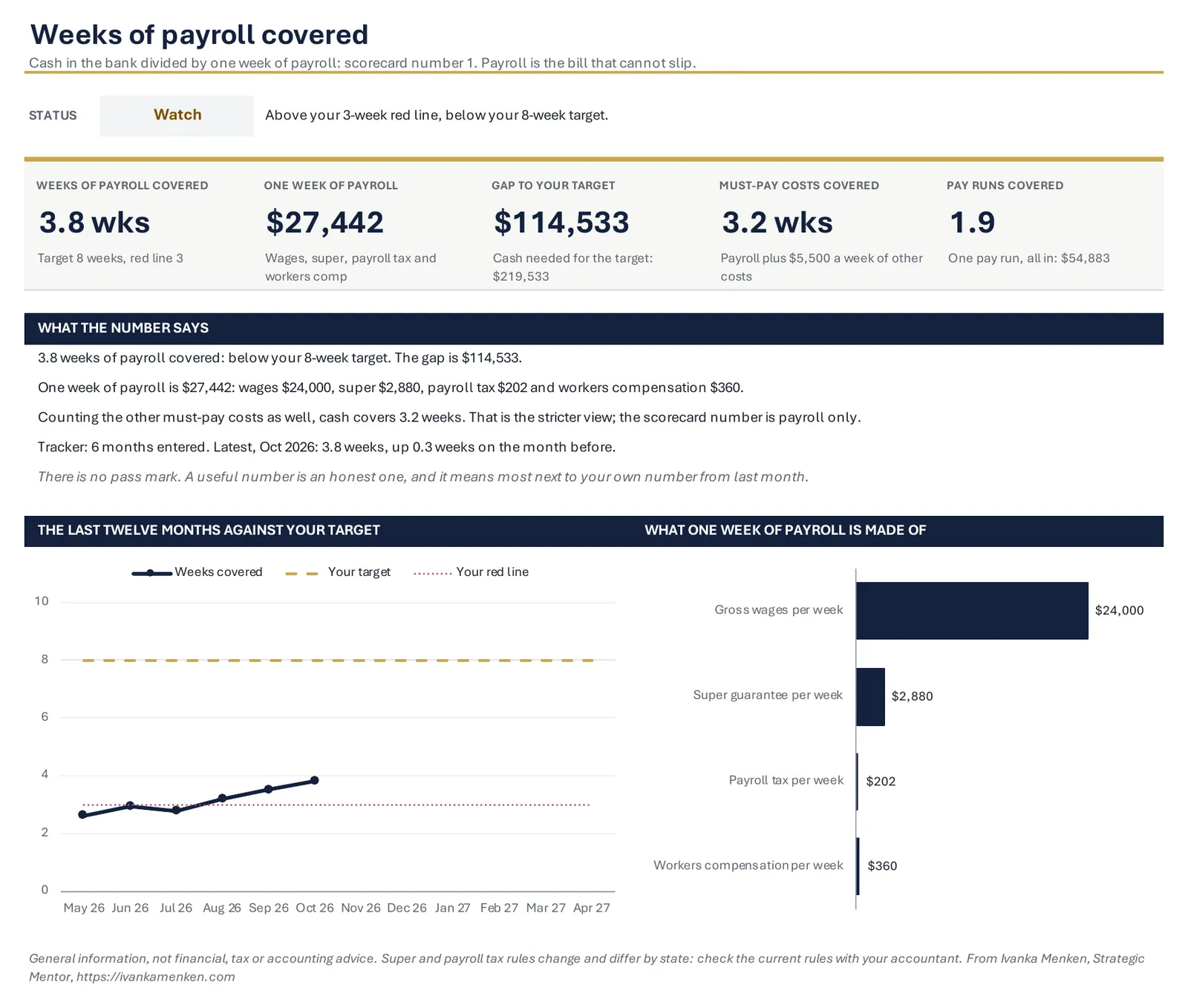
- Dashboard: weeks of payroll covered, one week of payroll, the gap to your target, must-pay costs covered and pay runs covered, a green, amber or red status, plain-English readings, a 12-month line chart against your target and a chart of what one week of payroll is made of.
- Tracker: twelve months of cash in the bank, the weeks covered each month, the change on last month, a status and the one number you want to move.
- Calculations: one week of payroll line by line and the cash each level of cover needs. Checks: fourteen pass or fix checks, from missing payroll to a red line above the target, rolled up to the cover.
| Line | Example |
|---|---|
| Gross wages per week | $24,000 |
| Super guarantee per week | $2,880 |
| Payroll tax per week | $202 |
| Workers compensation per week | $360 |
| One week of payroll | $27,442 |
| Weeks of payroll covered by cash in the bank | 3.8 |
| Gap to an 8-week target | $114,533 |
Line Gross wages per week
- Example
- $24,000
Line Super guarantee per week
- Example
- $2,880
Line Payroll tax per week
- Example
- $202
Line Workers compensation per week
- Example
- $360
Line One week of payroll
- Example
- $27,442
Line Weeks of payroll covered by cash in the bank
- Example
- 3.8
Line Gap to an 8-week target
- Example
- $114,533
HOW TO USE IT
How do you use the payroll cover calculator?
- 1Enter cash in the bankType today's cleared balance across your business accounts into the gold cell, without receipts you are still waiting for.
- 2Enter one pay runGross wages for one pay run, before super, then pick weekly, fortnightly or monthly. The sheet turns any pay cycle into one week of wages.
- 3Check super, payroll tax and workers compensationSuper guarantee is 12%. Payroll tax rates and thresholds vary by state, so enter your own effective rate, or 0 if you are under the threshold. Add your workers compensation rate and any other must-pay weekly costs.
- 4Set your target and red lineYour own target, in weeks. At or above it the status is green, between your red line and the target it is amber, below the red line it is red. The dashboard shows the gap in dollars.
- 5Write it down monthlyOnce a month, put cash in the bank on the Tracker sheet. The line chart shows the trend against your target, next to your own number from last month.
WHAT IT MEANS
What does the result mean for cash and payroll?
Weeks of payroll covered by cash in the bank is the first of the five numbers on Ivanka Menken's monthly scorecard: the number behind the monthly fear. Payroll is the bill that cannot slip, so counting cash in weeks of payroll says more than a bank balance does.
There is no pass mark. A useful number is an honest one, and it means most next to your own number from last month. If it is falling while revenue grows, the chain usually starts with price: thin prices leave thin margins, and growth on thin margins uses cash faster than it brings it in.
It is not accounting or financial advice. Super guarantee is 12% and super timing rules have changed, and payroll tax rates and thresholds differ by state. Check the current rules with your accountant or bookkeeper.
FREQUENTLY ASKED
What do founders ask about this template?
How do you calculate weeks of payroll covered?
Divide cash in the bank by one week of payroll. One week of payroll is gross wages for a week plus the super guarantee on those wages, plus payroll tax if your wages are over your state's threshold, plus workers compensation. The spreadsheet does the arithmetic, shows the result to one decimal place and compares it with the target you set.
Should payroll include super and payroll tax?
Yes, if you want the number to reflect what payroll really costs. Super is due on top of gross wages, and payroll tax is worked out on wages including super once you pass the threshold in your state. Ivanka Menken's definition is cash in the bank divided by one week of payroll, so the spreadsheet includes both and lets you set payroll tax to zero if it does not apply.
What is a good number of weeks of payroll to have in the bank?
Ivanka Menken does not set a benchmark, because the right cover depends on how fast clients pay, how lumpy your receipts are and how fixed your payroll is. The spreadsheet lets you set your own target and shows the cash it would take to hold it. What matters is whether the number is moving in the right direction month by month.
Can I track the number over time?
Yes. The Tracker sheet has twelve months: cash in the bank, one week of payroll, weeks covered, the change on last month and a status, with a line chart against your target on the dashboard. Mentoring clients fill in the same number every month beside four other numbers and read it with Ivanka Menken at month 3 and month 6.
Why is there a stricter must-pay figure as well?
Because rent, loan repayments and insurance cannot slip either. The scorecard number counts payroll only, so it stays comparable from month to month. The dashboard also shows weeks of must-pay costs covered, which adds the other weekly costs you choose, so you can see the standard number and the stricter view side by side.
Download the weeks of payroll covered calculator
Download the spreadsheetFree · No email required
The other templates
If one number keeps you up at night, Ivanka reads it with founders inside her 1:1 mentoring.